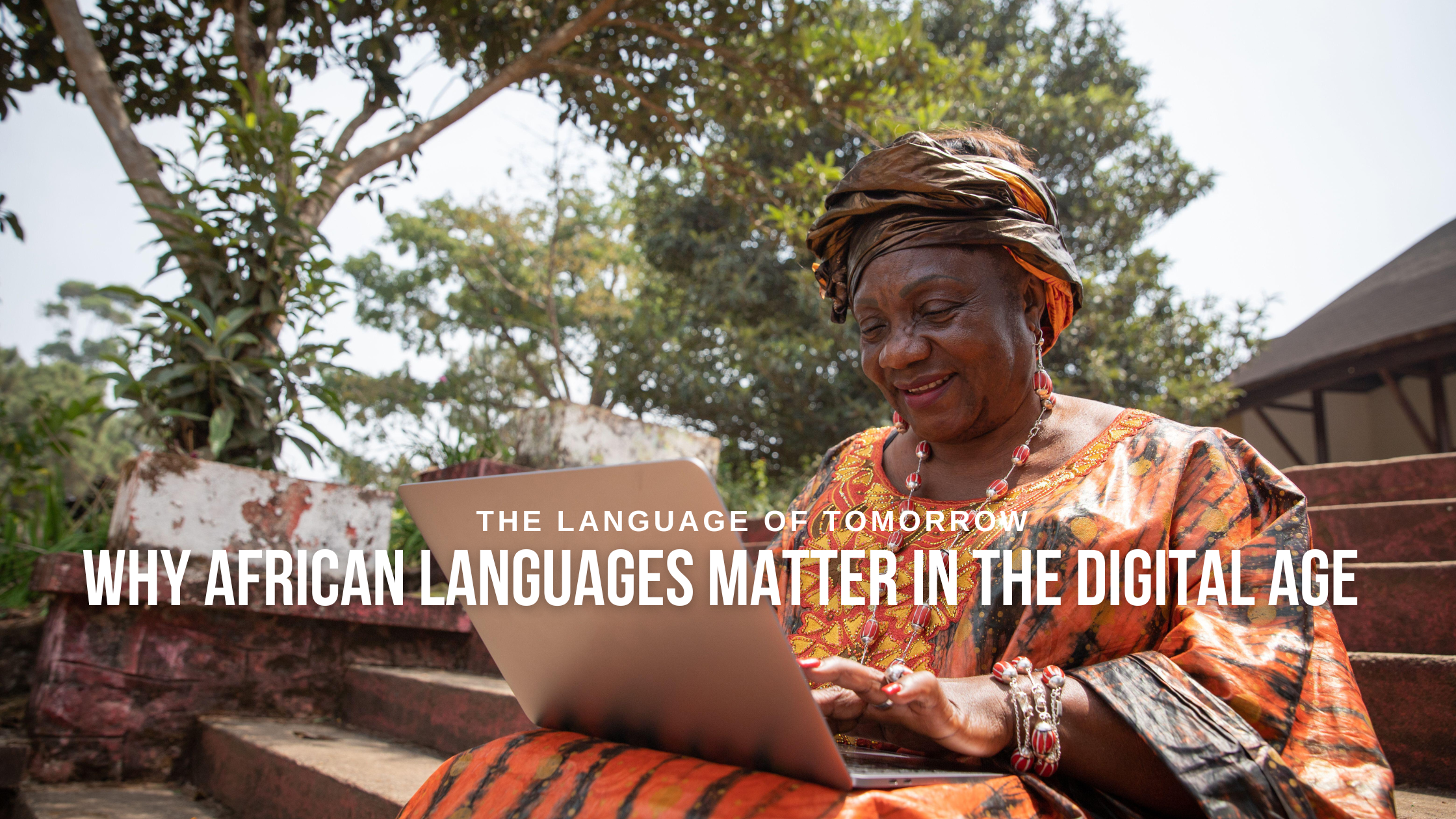

Why African Languages Matter in the Digital Age
Open almost any app, scroll through a news platform, or interact with an AI assistant, and you will likely encounter English, French, or Portuguese. These languages dominate search results, shape online discourse, and structure the architecture of digital platforms. They connect us globally. But they also quietly define who feels at home online — and who does not.
Across Africa, the overwhelming majority of digital content is produced in colonial languages. This reality is not neutral. It shapes access to knowledge, participation in public life, and the direction of technological development itself. In the digital age, language is infrastructure.
The Cost of Linguistic Exclusion
Language carries history, memory, and identity. When African languages are absent from digital spaces, millions are not simply inconvenienced; they are structurally excluded. Educational platforms, health resources, financial services, and civic information are often accessible only in languages that many Africans use as second or third languages. Afrobarometer data suggests that a significant portion of Africans struggle to use colonial languages fluently. This linguistic gap translates directly into informational inequality.
Take, for example, a student in the Eastern Cape using a tablet for schoolwork. If the learning platform is only available in English, comprehension becomes a barrier rather than a bridge. A health chatbot in French offers little reassurance to a Wolof-speaking mother in Senegal. Access to devices without language access is a partial inclusion at best. Digital divides, therefore, are not only about connectivity. They are about comprehension. When language is misaligned with lived reality, participation weakens. And when participation weakens, so does democracy.
Language as Technological Power
The digital ecosystem is increasingly shaped by artificial intelligence, machine learning and data-driven systems. These systems learn from what is available. If African languages are underrepresented in datasets, they are underrepresented in technological futures.
This creates a feedback loop:
Limited digital presence → limited AI training data → limited tool development → continued marginalisation.
Meanwhile, economic opportunities are tied to linguistic inclusion. Research consistently shows that consumers are more likely to engage with and trust platforms that operate in their native language. In African markets, campaigns delivered in local languages significantly outperform English-only messaging. Language accessibility drives adoption, engagement and growth.
As projections estimate that AI could contribute trillions to Africa’s economy in the coming decades, a critical question emerges: who will benefit if the systems powering that growth cannot understand the languages most Africans speak?
Multilingual digital systems are not cultural luxuries. They are economic necessities.
Innovators Reclaiming Digital Space
Despite structural constraints, African technologists, educators and creatives are reshaping the landscape.
Developers in South Africa are building reading apps in isiXhosa and isiZulu to strengthen early literacy. AI researchers in Nigeria are constructing datasets in Yoruba and Hausa to enable voice technologies to respond meaningfully to local users. Podcasters in Swahili are expanding political and cultural discourse in East Africa. Volunteer communities are translating Wikipedia entries into African languages, ensuring that global knowledge includes local voice.
These efforts do more than localise content. They challenge the assumption that innovation must default to colonial language frameworks.
They signal a deeper shift: that Africa’s digital future must be linguistically self-determined.
The Structural Challenges
The path is not simple. Many African languages remain under-documented in computational form. Funding for language technology is uneven. Expertise in natural language processing for low-resource languages remains limited.
Yet these challenges reveal opportunity.
Developing tools in African languages requires collaboration between linguists, technologists, educators and communities. It requires public investment, private-sector engagement and regional coordination. It requires treating language technology as public infrastructure rather than niche innovation.
Institutions such as the African Academy of Languages and emerging language technology initiatives are laying foundations, but scale will demand broader political and economic commitment.
Culture Meets Code
When African languages enter digital systems, something profound shifts.
A child learning to code in isiXhosa is not merely translating syntax — she is expanding the cognitive space of innovation. A grandmother receiving health information in Luganda is not simply consuming content — she is participating in digital citizenship.
Language shapes how technology feels. Whether it feels foreign or familiar. Extractive or empowering.
The digital age does not have to flatten linguistic diversity in the name of efficiency. It can, instead, amplify it.
The Future is Multilingual
Africa’s demographic growth and technological adoption position the continent as a defining force in the global digital economy. But participation without linguistic inclusion is incomplete.
Policymakers must recognise African languages as strategic assets. Technology companies must invest in multilingual AI training and content moderation. Creators must continue to produce, code and publish in the languages that reflect lived experience.
The question is not whether African languages belong in the digital age. The question is whether the digital age can afford to ignore them. When technology speaks in the languages people think, dream and debate in, it ceases to feel imported. It becomes owned.
African languages matter not only because they preserve heritage, but because they determine who participates in shaping the future. A truly inclusive digital transformation will not be monolingual. It will be multilingual — by design, not by translation. And only then will the language of tomorrow truly belong to us all.